



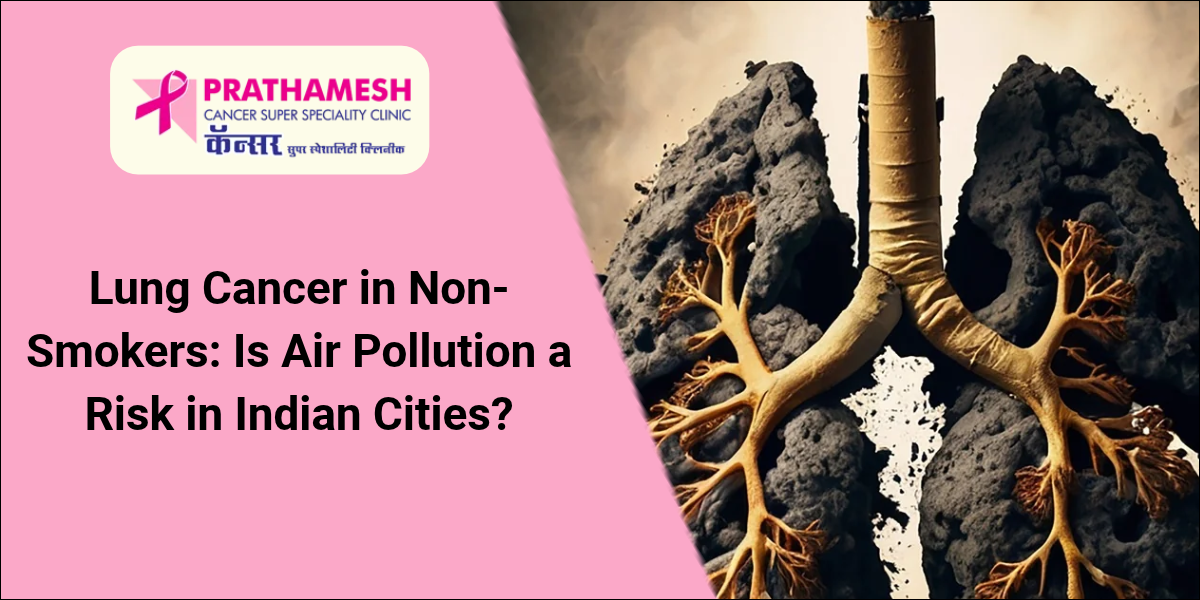
When people hear “lung cancer”, they usually think of a long-term smoker. Yet doctors in India now see many patients with lung cancer in non-smokers, including women and adults who never touched a cigarette. This has raised a natural question: could the air we breathe in busy Indian cities play a part? This guide explains what is known about air pollution and lung cancer, which other causes matter, and when a symptom deserves a proper check.
Can Non-Smokers Get Lung Cancer?
Yes. Worldwide, an estimated 10 to 25 percent of lung cancers occur in people who have never smoked, and several Indian hospital series report a share at the higher end of that range. Lung cancer in never-smokers is often a different disease from smoking-related lung cancer. It is more often adenocarcinoma, a type that starts in the outer parts of the lung, and it more often carries specific gene changes such as EGFR or ALK alterations. These changes can be tested in a biopsy sample and may influence treatment planning.
Is Air Pollution a Risk Factor?
The evidence points to a real link, although it does not mean every person exposed will develop cancer. The International Agency for Research on Cancer has classified outdoor air pollution and particulate matter as carcinogenic to humans. Studies from several countries have linked long-term exposure to fine particles (PM2.5) with a higher rate of lung cancer, especially adenocarcinoma, even among people who do not smoke.
Fine particles are small enough to travel deep into the lungs. Over many years they may cause chronic inflammation and damage to the cells lining the airways. In cities such as Pune and Pimpri Chinchwad, the main sources include vehicle exhaust, construction dust, industrial emissions, waste burning and, in winter, smog that traps pollutants close to the ground.
It is important to be realistic. Pollution is one risk factor among several, and the risk for any single person depends on how long and how heavily they are exposed, along with genes and other exposures. A doctor cannot say that pollution caused a particular person’s cancer.
Other Causes of Lung Cancer in Non-Smokers
Air pollution is rarely the only factor to consider. Other known or suspected risks include:
- Second-hand smoke: long-term exposure at home or work raises risk.
- Indoor smoke: cooking on wood, coal, dung cakes or kerosene in poorly ventilated kitchens.
- Radon gas: a natural radioactive gas that can collect indoors in some regions.
- Workplace exposure: asbestos, silica, diesel exhaust, welding fumes and certain chemicals.
- Family history: a close relative with lung cancer may point to inherited susceptibility.
- Past lung disease or radiation: chronic scarring of the lung or earlier chest radiotherapy.
Symptoms You Should Not Ignore
Early lung cancer often causes no symptoms. When symptoms appear, they are easy to mistake for a cold, asthma or tuberculosis. In India, tuberculosis is a common first guess, so a cancer diagnosis can be delayed. See a doctor if you notice:
- A cough that lasts more than three weeks or changes in character
- Coughing up blood or rust-coloured sputum
- Breathlessness, wheeze or chest pain that does not settle
- Hoarseness of voice that lasts for weeks
- Repeated chest infections in the same area of the lung
- Unexplained weight loss, loss of appetite or constant tiredness
These symptoms have many non-cancer causes, but they should not be treated at home for weeks. A cough that does not respond to a proper course of treatment needs imaging.
How Lung Cancer Is Diagnosed
Assessment usually starts with a chest X-ray, followed by a CT scan of the chest if there is any doubt. A tissue biopsy confirms the diagnosis and identifies the cell type. Molecular tests on the sample look for gene changes. Further scans, such as PET-CT, may be advised to see whether the disease has spread. This is called staging, and it guides every treatment decision.
Routine screening with low-dose CT is meant for selected high-risk groups, mainly heavy long-term smokers. It is not recommended for all non-smokers, so do not order scans on your own without a doctor’s advice.
Treatment Options
Treatment depends on the type, stage, gene test results and your general health. A team decision between a surgical oncologist, medical oncologist, radiation oncologist and pathologist is usual. Options may include:
- Surgery: for suitable early-stage tumours, part of the lung can be removed.
- Radiotherapy: used alone or alongside other treatment.
- Chemotherapy: given before or after surgery, or for later-stage disease.
- Targeted therapy and immunotherapy: chosen based on molecular test results.
Results vary from person to person, and no doctor can promise a specific outcome. You can read more about how thoracic cancer affects the lungs and chest organs and about the clinic’s thoracic cancer treatment services.
Practical Ways to Reduce Your Exposure
You cannot clean the whole city’s air, but you can limit your own exposure:
- Check the daily Air Quality Index (AQI) and reduce outdoor exercise on poor-air days.
- On heavily polluted days, a well-fitted N95 or FFP2 mask filters fine particles better than a cloth mask.
- Do not allow smoking inside the home or car.
- Switch to cleaner cooking fuel such as LPG or induction, and ventilate the kitchen.
- Avoid burning garbage, leaves or crop waste near living areas.
- Use protective equipment if your job involves dust, fumes or chemicals.
- Keep windows closed during peak smog hours and consider an indoor air purifier with a HEPA filter if you can.
For general guidance on early detection, see the clinic’s page on how to prevent cancer or find it early.
Frequently Asked Questions About Lung Cancer in Non-Smokers
Does living in a polluted city mean I will get lung cancer?
No. Pollution raises risk at the population level, but most people exposed to polluted air do not develop lung cancer. Risk depends on many factors working together.
Can lung cancer in a non-smoker be found early?
It can be, but it is often found late because symptoms are mild or mistaken for other illnesses. A persistent cough, blood in sputum or an abnormal chest X-ray should lead to a CT scan.
Is lung cancer in non-smokers hereditary?
Most cases are not inherited. A small share is linked to family history or inherited gene changes, so tell your doctor if relatives have had lung or other cancers.
Do air purifiers or masks prevent lung cancer?
There is no proof that they prevent cancer. They may reduce how much fine particulate matter you breathe in, which is a sensible step, but they do not offer complete protection.
Should non-smokers get a yearly chest CT?
Not routinely. Low-dose CT screening is advised only for selected high-risk people, usually long-term smokers. Discuss your own risk with a doctor before any scan.
Is a long cough always tuberculosis or cancer?
No. Asthma, infections, acid reflux and allergies are far more common causes. The point is to have a cough that lasts beyond three weeks examined rather than guessed at.
Talk to Dr. Ashish Pokharkar About a Lung or Chest Concern
If you have a lasting cough, an abnormal scan or a worry about lung cancer risk, you can consult Dr. Ashish Pokharkar, surgical oncologist (MBBS, MS, MCh Surgical Oncology, FIAGES, FALS), who has trained at BJ Medical College and Sassoon Hospital, Pune, and completed his MCh at Tata Memorial Hospital, Mumbai.
Clinic details
- Clinic: Prathamesh ENT & Cancer Hospital (2nd floor)
- Address: Pune-Nashik Highway, near Janjira Hotel, Kendriya Vihar Road, Sector Number 4, Moshi, Pune, Maharashtra 412105
- Phone: +91 9765395875
Bring your earlier X-rays, CT scans and reports. Contact the clinic to book a consultation and for current timings.
