




Introduction
Have you ever felt chest pain or a cough that just won’t go away – and wondered if it could be something serious? You’re not alone. Thousands of people across India face this fear every day. When thoracic cancer is involved, understanding what’s happening inside your chest can make all the difference between catching it early and missing the window for effective treatment.
Thoracic cancer refers to cancers that develop in the chest region – including the lungs, the lining around them, the food pipe, and the central chest space. In India, lung cancer alone makes up nearly 6.9% of all new cancer cases each year. Yet many people don’t seek help until symptoms become hard to ignore.
This blog explains — in simple, clear language – exactly how thoracic cancer affects the lungs and chest organs, what symptoms to watch for, and when to see a doctor.
What Is Thoracic Cancer?
Thoracic cancer is an umbrella term for cancers that grow inside the chest cavity. The chest is a busy, tightly packed space. The lungs sit on either side. The heart and major blood vessels run through the middle. The food pipe (esophagus) passes through the back. The thymus gland sits just behind the breastbone.
When a tumor grows in any of these areas, it doesn’t stay quiet for long. It begins to press on neighboring organs, block airways, or disrupt blood flow – and that’s when symptoms start to appear.
The most common types include non-small cell lung cancer (the most frequent), small cell lung cancer (faster spreading), mesothelioma (affecting the lung lining), and thymic cancer (originating in the thymus gland).
How Thoracic Cancer Damages the Lungs
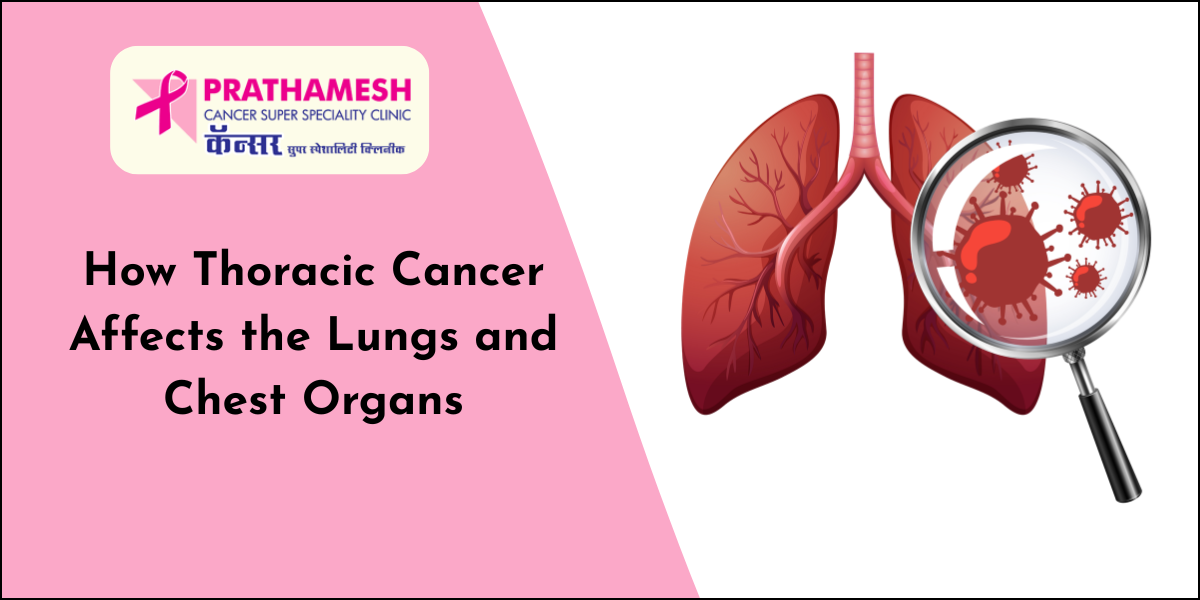
The lungs are the most commonly affected organ in thoracic cancer, and the damage can develop in several serious ways.
Blocked airways are one of the first problems. A tumor pressing on or growing inside the breathing tubes causes chronic coughing, wheezing, and breathlessness. Many patients initially mistake this for asthma or a stubborn chest infection.
Lung collapse (atelectasis) happens when a tumor fully blocks a breathing tube, cutting off air to part of the lung. That section deflates, reducing the patient’s breathing capacity and causing sudden, severe shortness of breath.
Fluid around the lungs (pleural effusion) is another common complication. Cancer irritates the lung lining and causes fluid to collect in the space around the lung. This fluid presses on the lungs from outside, making breathing painful and difficult. Research shows this affects roughly 15% of all cancer patients at some point.
Coughing up blood (hemoptysis) occurs when the tumor invades blood vessels inside the lung. Even a small amount of blood in sputum should never be ignored – it needs urgent medical evaluation.
Effects on Other Chest Organs
Thoracic cancer doesn’t stop at the lungs. Because everything in the chest sits so close together, nearby organs are often affected too.
The heart can be impacted when tumors grow near or into the pericardium – the protective sac around the heart. Fluid builds up inside this sac and can stop the heart from pumping properly, a dangerous situation that needs immediate treatment.
The major blood vessels are also at risk. When a tumor presses on the superior vena cava – the large vein carrying blood back to the heart – it causes swelling of the face, neck, and arms, along with headaches. This is known as Superior Vena Cava (SVC) Syndrome.
The food pipe (esophagus) can become compressed by nearby tumors, making it hard to swallow solid foods. Patients lose weight rapidly as a result, weakening the body at a time when it needs strength the most.
The voice box and vocal cords can be affected when cancer puts pressure on the nerve controlling them. A hoarse or changed voice that doesn’t go away is a symptom that many people dismiss – but it can be a real warning sign of thoracic cancer.
The diaphragm – the muscle that powers your breathing – can be paralyzed if the nerve controlling it is pressed by a tumor. This causes constant breathlessness and difficulty lying down flat.
8 Warning Signs You Should Never Ignore
A cough lasting more than 3 weeks that isn’t getting better
Coughing up blood, even in tiny amounts
Shortness of breath during normal daily activities
Chest pain that gets worse when you breathe or cough
Sudden, unexplained weight loss
Hoarse voice that doesn’t go away
Difficulty swallowing food
Swelling of the face, neck, or arms
If you have any of these – especially combined with a history of smoking or a family history of cancer – please see a doctor soon.
FAQ
Q. Is thoracic cancer the same as lung cancer?
No. Lung cancer is the most common type, but thoracic cancer also includes cancers of the food pipe, the lung lining, the thymus, and the central chest region.
Q. Can thoracic cancer be treated successfully?
Yes, especially when found early. Stage I patients treated with surgery have survival rates of 60–70%. The earlier it’s caught, the more treatment choices are available.
Q. Is a hoarse voice really a sign of cancer?
It can be. A voice change caused by pressure on a chest nerve is a known symptom of thoracic cancer. If hoarseness lasts more than 3 weeks without an obvious cause, get it checked.
Q. Who should I see if I suspect thoracic cancer in Pune or PCMC?
Consult a cancer specialist and cancer surgeon who focuses on chest cancers. Dr. Ashish Pokharkar in Pimpri Chinchwad (PCMC) is a trusted name for patients across Pune looking for focused cancer care.
Consult Dr. Ashish Pokharkar – Cancer Specialist & Cancer Surgeon in Pimpri Chinchwad (PCMC)
If you or a loved one is experiencing symptoms of thoracic cancer, do not ignore them. Early diagnosis and timely treatment can make a life-saving difference. Persistent cough, chest pain, breathing difficulty, or unexplained weight loss should never be overlooked. Seeking expert medical advice at the right time can improve treatment outcomes and recovery.
Dr. Ashish Pokharkar is a trusted cancer specialist and cancer surgeon in Pimpri Chinchwad (PCMC), helping patients across Pimpri, Chinchwad, and Pune receive accurate diagnosis and advanced cancer care.
Book your consultation with Dr. Ashish Pokharkar today — because when it comes to thoracic cancer, every day matters.
